
by Dr. Brie Woodruff, DNP, ARNP, FNP-C
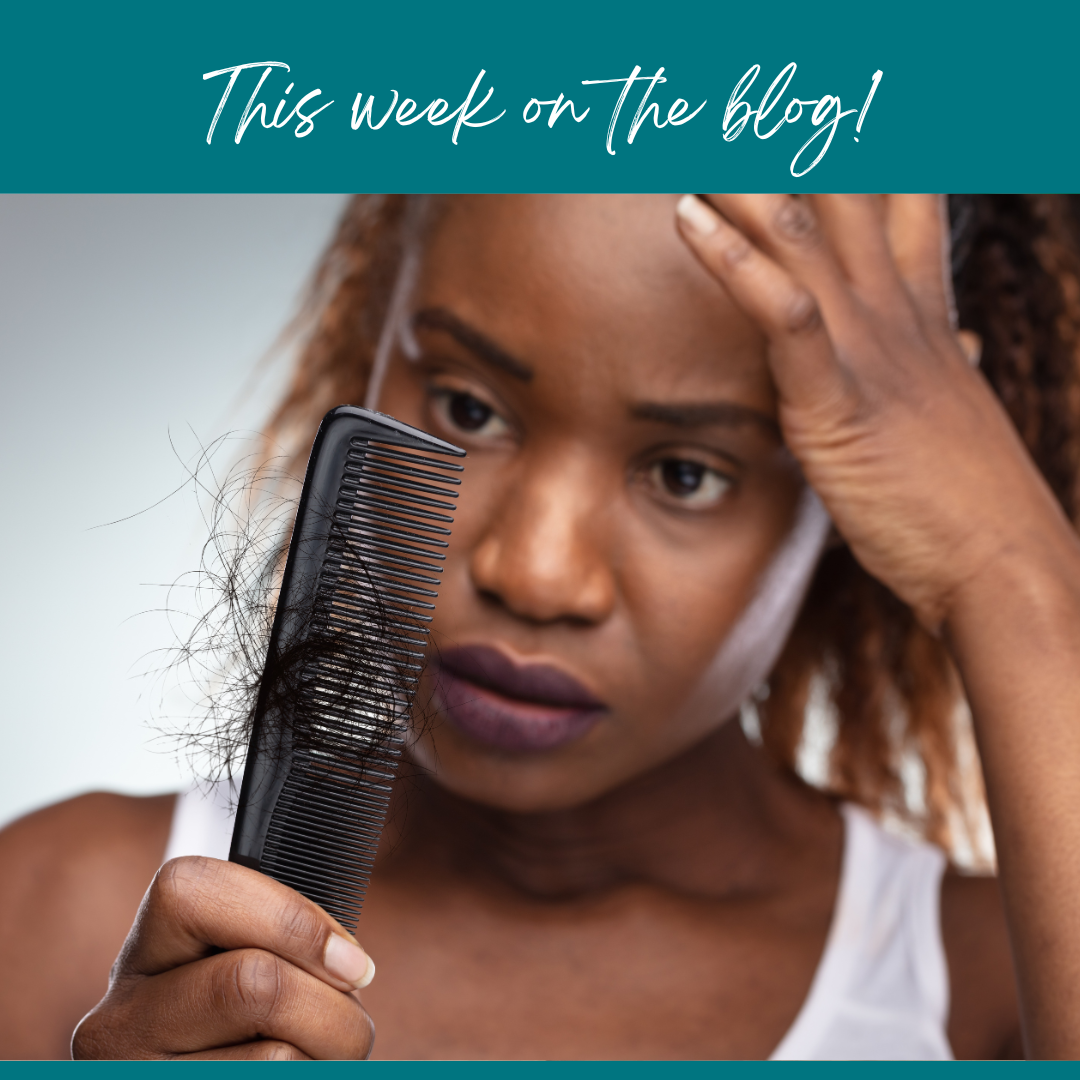
Hair loss affects up to 52% of pre- and postmenopausal women, making it one of the most common changes during this life transition. While it can be distressing, understanding why it happens and what treatments are available can help you take control of your hair health.
Why Does Hair Loss Occur During Perimenopause and Menopause?
During perimenopause and menopause, your body undergoes significant hormonal changes that directly affect your hair follicles. The decline in estrogen production in relation to androgen hormones (testosterone) and progesterone can cause several changes to your hair:
Hair follicles become smaller
The growth phase of your hair cycle shortens
Hair strands become thinner and finer
Hair density decreases
Hair texture may change
These Changes Can Result In:
Wider part lines
More visible scalp
Decreased hair volume and fullness
Thinner ponytails
Variation in hair strand thickness
So what can you do to address these changes?
Below are some common medical and natural approaches to treatment.
Proven Medical Treatment Options
Minoxidil (Rogaine)
Minoxidil is the most well-studied and FDA-approved treatment for female hair loss. Before using Minoxidil it is important to determine if this treatment will work for you and to evaluate for underlying causes of hair loss beyond peri/menopause. Your provider can help you to evaluate if this is a good treatment option for you. Important things to know about Minoxidil: About 50% of women experience hair regrowth with consistent useResults typically appear after 3-6 months of regular use. Treatment must be continued to maintain results
Antiandrogen Medications
For women with hormonal imbalances or those who don't respond well to minoxidil alone, medications that block androgens may be helpful. Some common anti-androgen medications used for peri/menopausal hair loss include:
Spironolactone: A medication that blocks androgen receptors
Finasteride and dutasteride: Medications that reduce androgen production (used off-label in women)
Talk to your doctor if these options may be right for you.
Natural and Botanical Options
Several plant-based treatments show promise for peri/menopausal hair loss:
Saw palmetto: May reduce the conversion of testosterone to its more potent form (DHT) by 30-40%
Rosemary oil: Promotes scalp circulation similar to minoxidil
Ginseng: May enhance hair follicle growth
Pumpkin seed oil: Another natural DHT blocker
While these options are generally safe and well-tolerated, the evidence supporting them is less robust than for minoxidil. They may work best as complementary treatments alongside proven therapies.
Nutritional Support
While supplements alone won't reverse peri/menopausal hair loss, addressing deficiencies and assessing underlying causes of hair loss can support overall hair health. Areas that you may want to look at personally and with your provider:
Ensure adequate iron, vitamin D, and essential minerals
Maintain a balanced diet rich in protein (see Dr. Woodruff’s blog post on protein)
Avoid excessive biotin supplementation, as it can interfere with certain medical tests
Consider having your provider screen you for iron deficiency anemia, B-vitamin deficiency, and thyroid dysfunction.
What About Hormone Therapy?
Hormone therapy (HT) may offer some benefits for hair; however, it's not approved as a standalone treatment for hair loss. That said, if you're already considering HT for other peri/menopausal symptoms, the potential hair benefits can be discussed with your healthcare provider as part of your overall treatment plan. Keep in mind that testosterone therapy, which can be helpful for libido, can worsen/cause hair loss.
Taking Actions on Next Steps
While this can be a frustrating experience for many women, I hope it feels encouraging knowing there are many things you can do to support your symptoms. If you are concerned about hair loss and are ready to support your symptoms, I invite you to schedule an appointment with myself or another provider at Neighborhood Naturopathic.
See you in clinic,
Dr. Woodruff
References
Menopause and Hair Loss in Women: Exploring the Hormonal Transition. Gupta AK, Economopoulos V, Mann A, Wang T, Mirmirani P. Maturitas. 2025;198:108378. doi:10.1016/j.maturitas.2025.108378.
Skin, Hair and Beyond: The Impact of Menopause. Zouboulis CC, Blume-Peytavi U, Kosmadaki M, et al. Climacteric : The Journal of the International Menopause Society. 2022;25(5):434-442. doi:10.1080/13697137.2022.2050206.
Botanical Drug Preparations for Alleviating Hair Loss in Menopausal Women: A Global Ethnopharmacological Mini-Review. Huang Z, Zhao WJ, Gao YJ, et al. Frontiers in Pharmacology. 2025;16:1725691. doi:10.3389/fphar.2025.1725691.
Addressing the Root Causes of Female Hair Loss and Non-Pharmaceutical Interventions. Leavitt A, Hawkins SD, Kindred C, et al. Journal of Drugs in Dermatology : JDD. 2025;24(7):659-662. doi:10.36849/JDD.8763.
Hair Loss in Women. Olsen EA. The New England Journal of Medicine. 2025;393(15):1509-1520. doi:10.1056/NEJMcp2412146.
Interventions for Female Pattern Hair Loss. van Zuuren EJ, Fedorowicz Z, Schoones J. The Cochrane Database of Systematic Reviews. 2016;(5):CD007628. doi:10.1002/14651858.CD007628.pub4.
Androgenetic Alopecia in Women: A Narrative Review of Pathophysiology, Clinical Evaluation, and Treatments. Kearney CA, Brinks AL, Lawrence CN, et al. American Journal of Clinical Dermatology. 2026;:10.1007/s40257-026-01009-2. doi:10.1007/s40257-026-01009-2.Open Evidence (2026). https://www.openevidence.com/
Hormone Replacement Therapy and Hair: A Review for Trichologists Treating Menopausal Women. Lee J, Krishnegowda R, Miteva MI. Dermatology (Basel, Switzerland). 2026;:1-10. doi:10.1159/000551153.
Understanding Hormonal Therapies: Overview for the Dermatologist Focused on Hair. Desai K, Almeida B, Miteva M. Dermatology (Basel, Switzerland). 2021;237(5):786-791. doi:10.1159/000512888.